Plug-in electric vehicles (PEVs), such as plug-in hybrids and electric vehicles (EVs), are important components of our technology portfolio for achieving energy security and sustainability. However, the current market share for these vehicles is small. Obstacles to increasing market share include high vehicle cost, driving range limitations for EVs, charging availability, and limited vehicle choice, to name a few. Policy makers and stakeholders need a better understanding of the effect of these factors on market penetration in order to develop effective strategies to advance the commercial viability of these vehicles.
The Transportation Energy Evolution Modeling (TEEM) Program at Oak Ridge National Laboratory (ORNL) recently performed an analysis of the market share potential of plug-in hybrids and EVs to determine (1) the approximate distribution of PEV market shares in future years and (2) the key factors that affect market penetration. The study projected market share for plug-in hybrids and EVs from 2010 through 2050 by performing a Monte Carlo simulation using the Market Acceptance of Advanced Automotive Technologies (MA3T) model and @Risk®. Details of the study are described in How Uncertain is the Future of Electric Vehicle Market: Results from Monte Carlo Simulations Using a Nested Logit Model.
Projected Market Penetration and Uncertainty
The mean projected market penetration for PEVs in the study is 21% by 2030 and 46% by 2050. The standard deviation and 90% confidence interval bands are shown in the projected PEV market share graph.
The analysis suggests that there is significant uncertainty in market penetration due to the high level of sensitivity to factors such as vehicle price and fuel costs.
Plug-in hybridy
One thousand simulations were performed while varying the values of 19 different factors affecting market penetration. The market penetration values—the percentage of market share—were projected for both plug-in hybrids and EVs. As shown in the histogram charts below, the projected market share of plug-in hybrids in 2030 ranges from 0% to 30% with a mean of 10% in 2030. A pronounced «spike» in values near 0% indicates the risk of low market penetration for these vehicles. The projected market share for 2050 has a similar range but a higher mean value of 17%. The spike near 0% still exists in 2050, but it is much smaller than in 2030. The research team investigated the cause of the spike near 0% and found it to be mostly related to scenarios with high plug-in hybrid vehicle price sensitivities and high consumer value of make/model diversity. This suggests that high initial price and limited vehicle selection could be significant obstacles to consumers purchasing plug-in hybrids.
Elektrické vozy
The projected penetration rate for EVs in these simulations is higher. Market share of EVs ranges from 0% to 26% with a mean of 11% in 2030 and ranges from 0% to 55% with a mean of 28% in 2050. Note that the distributions for EVs are more symmetrical than those for plug-in hybrids with no spike in values near 0%. This suggests that there is less risk of low market penetration for EVs.
Factors Affecting Market Penetration
Sensitivity analysis was performed on the factors affecting market penetration. The results for plug-in hybrids and EVs are presented in tornado charts below. The size of the bar indicates the strength of the correlation between that factor and market penetration. Values with a negative sign reduce market penetration as the value for that factor increases, and values with a positive sign increase market penetration as the value increases. For example, as price slope multiplier increases for plug-in hybrids and EVs, market penetration decreases. Conversely, as gasoline and diesel prices increase, market penetration increases.
Determining the sensitivity of the results to various market penetration factors allows planners and stakeholders to both assess risk and prioritize the potential obstacles to consumer acceptance of these vehicles. The results of this study also show that the factors that affect market penetration change over time and that, despite the similarities in the technologies, the factors for plug-in hybrids and EVs differ.
Plug-in hybridy
Consumer sensitivity to vehicle price is by far the greatest factor affecting plug-in hybrid market share in both 2030 and 2050. It is roughly twice as significant as the next factor for both of those projection years. The value of make/model diversity to consumers is the second most important factor in 2030 but slips to fourth in 2050. The coefficients for these two factors are negative. So, the more important vehicle price and selection are to consumers, the less attractive plug-in hybrids become. Perceived vehicle lifetime is the time a consumer plans to keep or get value out of the vehicle. Therefore, it affects both potential costs (e.g., loss of time re-charging, extra costs related to EV range limitations, etc.) and savings (e.g., fuel and maintenance savings). This is the third-ranking factor in 2030 but increases slightly by 2050 to become the second-most factor. Gasoline and diesel prices are a significant factor in the nearer term but become much less important by 2050. Conversely, the availability of Level 2 charging at home is less significant in the near term but much more important by 2050.
Elektrické vozy
The market penetration of all-electric vehicles is much more sensitive to gasoline and diesel prices than that of plug-in hybrids. It is the most important factor for EVs in 2030 and the second-most important factor in 2050. This is intuitive since EVs benefit much more from the price difference between electricity and gasoline/diesel since they operate on electricity all of the time. Driving range is the second-most significant factor in 2030 and decreases slightly by 2050, ranking third in importance. Similar to plug-in hybrids, the availability of Level 2 charging at home increases in importance over time. For EVs, it is the most important market penetration factor in 2050. Vehicle prices is important for EVs, though much less so than for plug-in hybrids. It is ranks third among factors in 2030, but ranks fifth among factors by 2050, dropping in significance by over half.
Závěry
Plug-in electric vehicles have the potential to account for roughly half of the light-duty vehicle market by 2050. However, there are significant risks for plug-in hybrids, especially if vehicle costs remain high and vehicle selection remains low. The risk of low market penetration for EVs is lower and more dependent upon gasoline and diesel prices and driving range limitations. Finally, for both plug-in hybrids and EVs, availability of Level 2 home charging is important to successful market penetration, especially in the long term.

Here at Electrifying we are more interested in the idea of pure electric vehicles than anything else, but we also like to think that we’re a broad church. Which means that as technology improves and things change, we take that into account.
Take, for instance, plug-in hybrids. Now in its basic form, a plug-in hybrid — or PHEV — is exactly what it says on the tin; a hybrid vehicle that can also be plugged in, and therefore able to utilise a little bit of cheaper electricity from the mains. But it’s also just a plain hybrid, so there’s an internal combustion engine (usually petrol or diesel) for when the electricity runs out.
Which it will, because when you’re trying to fit an engine, battery and electric drivetrain all into one car, space gets a little bit tight. That means the traction batteries (the ones that power the car) in PHEVs tend to be quite small — so you don’t get much electric range to play with.
This is where PHEVs have run into some controversy. Because of the way that the official tests are run, they can generate really extreme official mpg and efficiency figures — ones that are in no way achievable in the real world.
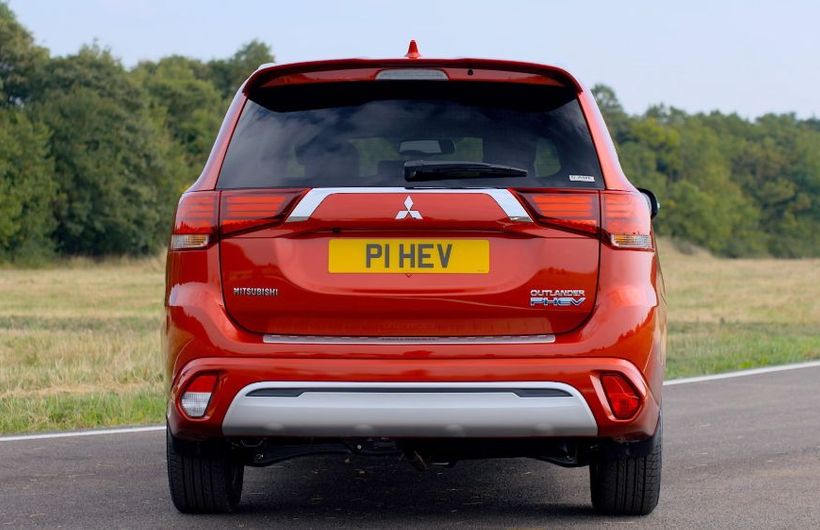
The Mitsubishi Outlander was a best seller, thanks to tax breaks
That means that they can be taxed at a lower rate, especially for businesses. But — and it’s a big but — they only work if you constantly plug them in and use the maximum amount of electricity possible — which a lot of people who bought them as company cars simply didn’t.
So you’d get, say, a Mitsubishi Outlander PHEV (one of the first practical PHEVs), running up and down the motorway, never plugging in, dragging around a never-used electric drivetrain and not being very efficient at all. Except at making tax bills cheaper. It all felt like a bit of a con.
Thing is, a PHEV sounds like it could be the best of both worlds, especially for people who might be a little bit nervous about committing to a full battery-electric vehicle (BEV). If you’ve got home charging and plug the car in whenever you get back, then all those local journeys and daily commutes can be achieved with electric power alone. But when you need to do a big trip — Cornwall to Edinburgh without stopping for more than five minutes seems to be a popular one in the comments section of YouTube — there’s a normal fossil fuelled engine to help you on your way. So you get used to plugging in, see the advantages and maybe think of a BEV for your next car.
But here’s where it stalls a bit: the small batteries in early PHEVs were supposed to be capable of nearly 30 miles of electric-only range. But it would only do about 15, and couldn’t be charged very quickly. Which means electric car drivers thought PHEVs seemed like an inefficient way of dealing with things.
Which makes most sense — a PHEV or a pure electric BEV?
Similarly, Range Rover P400e PHEV drivers thought they’d get 25 miles of e-range, but … didn’t. And the same could be said for most of the PHEVs that appeared a few years ago. Things have changed a bit now though. Where PHEVs originally seemed like accounting sleight-of-hand to make the most of tax rules, the latest generations really do seem to have upped their game: you can charge them quickly, some of the electric-only ranges have doubled.
If you’re talking about PHEVs that have appeared recently displaying plenty more usefulness than before, then how about the Vauxhall Astra Hybrid-e? Only a 12.4kWh battery, but a possible 40+ miles of electric only range, and in our experience, 35 miles is achievable — which should cover the majority of average UK commutes.
Then there’s a 1.6-litre turbocharged four-cylinder petrol engine as well, coupled with that electric motor. A 7kW home wallbox charges it up in under two hours, meaning that you can utilise cheap (er) electricity for all the short-range stuff, and still have the flexibility that a hybrid offers.
Others on offer include various Audis — all offering similar drivetrains and 40-ish miles of range, from the A3 Sportback TFSi-e, A6 TFSI-e, A7 and A8 TFSI-e, plus the SUV-ish ones — yes, Audi really did plop PHEV into most of its unsporting models — so you can have Q3, Q5, Q7 and Q8, all TFSi-e’d up to the eyeballs.
BMW is also in on the action, with the popular 330e or 530e (38 miles of range) and decidedly less-compromised dynamics, as well as the more modern 2-series range of bi-powered cars. So you can have a 225e or a 230e — and they boast up to 57 miles of battery-powered running. Interestingly, while we here at Electrifying are staring hard at the new BMW iX1 BEV, there’s also the X1 xDrive25e and 30e which offer similar ev-only range as the 2-series, with a 1.5-litre petrol engine, and electric motor on the rear axle and 14.2kWh battery. BMW seems good at this stuff — the X5 xDrive 45e is probably the pick of the large PHEV bunch.
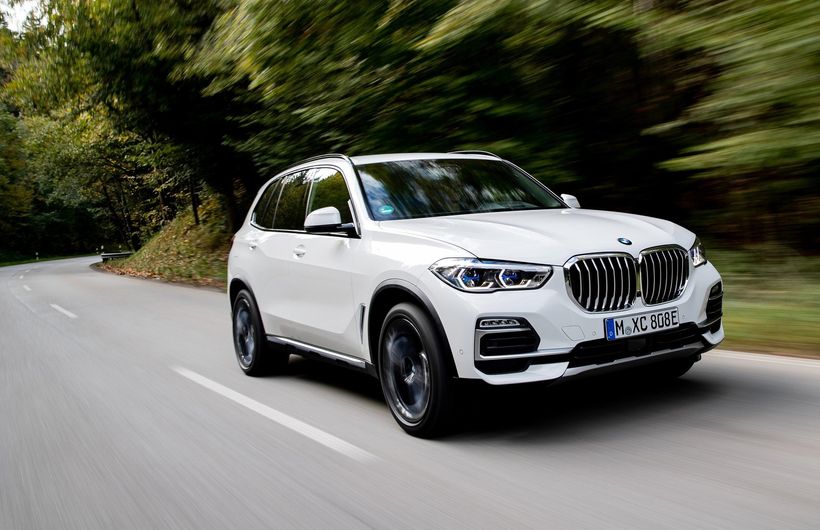
An X5 PHEV is cheaper for company car drivers than an X3
One of our favourite PHEVs is the Cupra Formentor eHybrid. Either 201 or 242bhp with a 1.4-litre engine and 113bhp electric motor with 36 miles of ev range, but wrapped up in a sort-of SUV package that’s actually loads of fun to drive — although that ev-range isn’t the best.
If you need something a bit bigger, then how about the Nissan Qashqai e-Power? Now this isn’t even a traditional PHEV — you can’t plug it in — but it does represent something a bit different. It’s a fossil-fuelled car, but one where the drivetrain is 100-percent electric; the 1.5-litre, 3-cylinder engine only acts as a generator to provide electricity for the battery. So you get the smooth and quiet aspects of a BEV (although not entirely — there’s still an engine running), but the convenience of no recharging. It’ll even monitor the noise the road makes and run the engine when the road surface is rough so the cabin isn’t overly disturbed.
In fact, when you dig, pretty much everyone has a PHEV, from Kia (Sportage, Niro) to Hyundai (Tucson, Santa Fe, Kona), Ford, Jaguar and Jeep. VW, Volvo, Renault, Toyota and Skoda. There’s even a Land Rover Defender — the P400e — but it only manages 27 miles of range. Probably the pick of that off-roady types is the new Range Rover P440e (434bhp) and P510e (503bhp) though: with 38.2kWh battery — positively enormous for a PHEV — they should manage a claimed range of 70 miles. Even if that’s not possible without driving like an absolute saint with sore feet, it’s going to get you a decent distance.
But perhaps the manufacturer with the most nailed-down PHEVs is Mercedes. Everything from the small A250e through the B250e and C300e (that’ll be 62-miles from a 25.4kWh battery for the C-Class), to the S580e L — an S-class limo with a 28.6kWh battery and 3.0-litre petrol V6 and 62 miles of silent running. The new GLC 300e we sampled — a big four-wheel drive SUV — managed 60 miles of range on a very cold day against a claimed 70-miles. Which is pretty stunning, really — although it’s wise to note that a 31.2kWh battery isn’t small and takes up boot space.
If you want examples of how much electrification helps perceived efficiency, then there’s even a Bentley Flying Spur PHEV, with bits from the Porsche Panamera and a modest 25-miles of range, plug-in Ferraris (SF90 and 296 GTB) that only get 15-ish miles on battery alone (though that is useful for sneaking to/from places on the quiet), and even a McLaren: the Artura. All come with plugs.

Mercedes’ PHEVs are arguably more impressive than the pure electrics in the range, although boot space is compromised
So if everyone jumped the bandwagon, what actually is the answer when it comes to PHEVs? It’s worth noting here that there has to be a kind of event horizon for ‘enough’ range from a PHEV battery when you start wondering why you don’t just have a pure electric car and forget about the internal combustion engine altogether. Is that 60-miles? One hundred? Because you will hit a point where the ICE just isn’t really getting used, unless you have some serious weekly commutes going on. And even so, with BEV ranges now comfortably in the high-200s, the use-case for PHEV looks to be on slightly shaky ground – unless you are just using one as a tax avoidance measure of course.
Ignoring the exotic cars which use the hybrid system as a performance-enhancing drug as much as anything else, PHEVs offer the comfort and convenience of internal combustion with tax-friendly tariffs and some of the advantages of pure electric. If nothing else, they get people used to plugging in.
But are PHEVs doomed in the long run? Probably. But for now, they can suit some people down to the ground. What do you think Electrifyers? Are some of the newer PHEVs with much better ev-only range more appealing? Would you ever consider one? Let us know.


